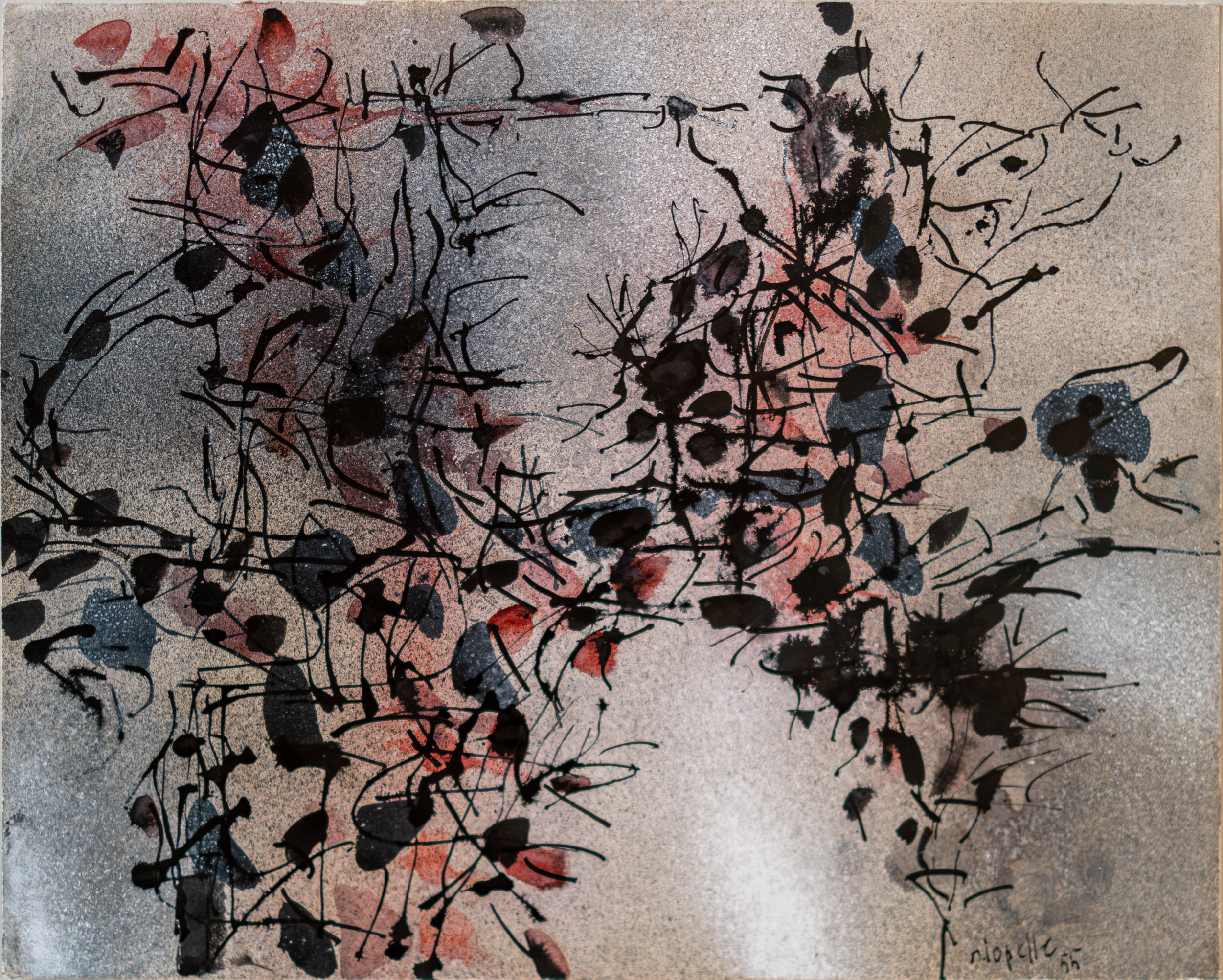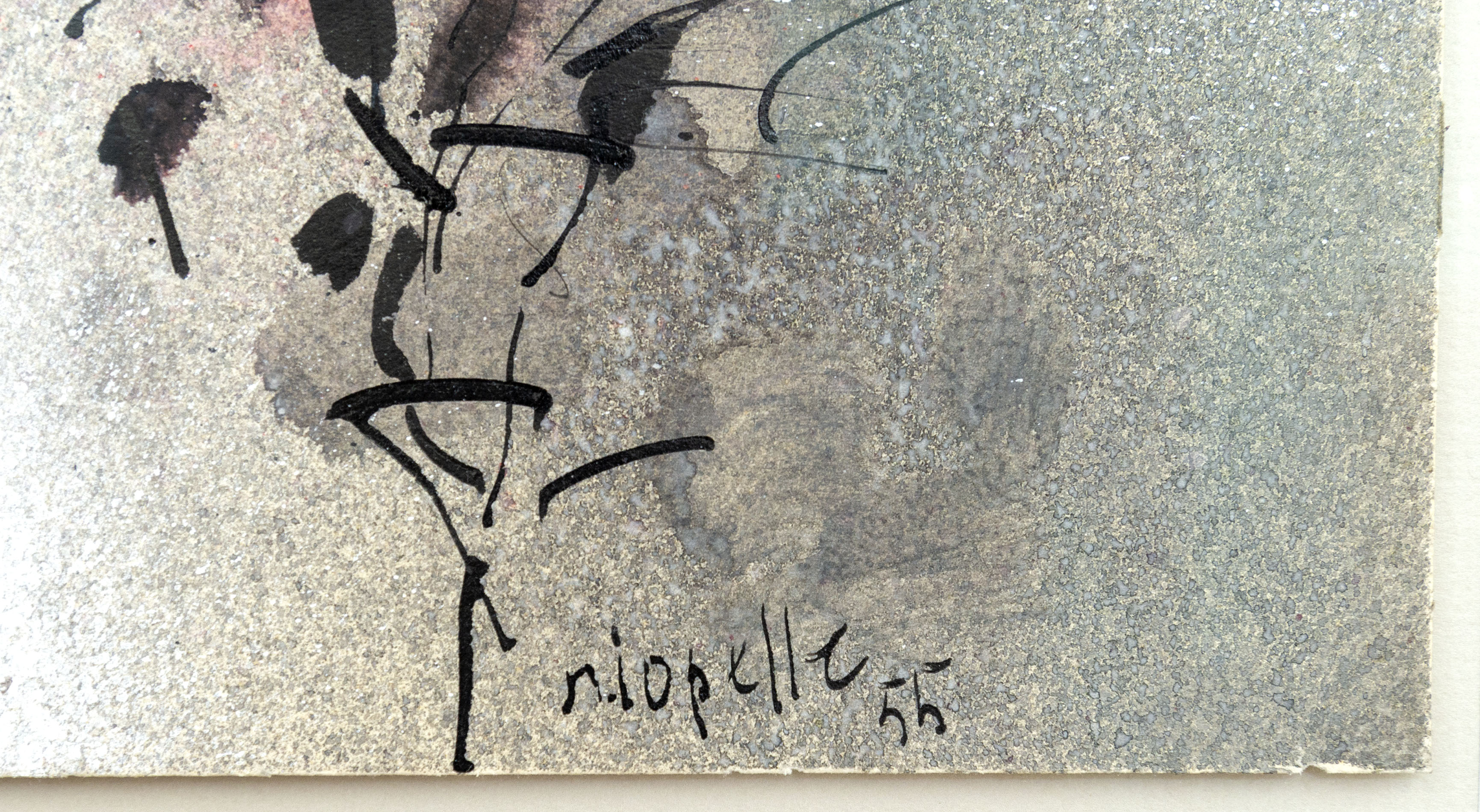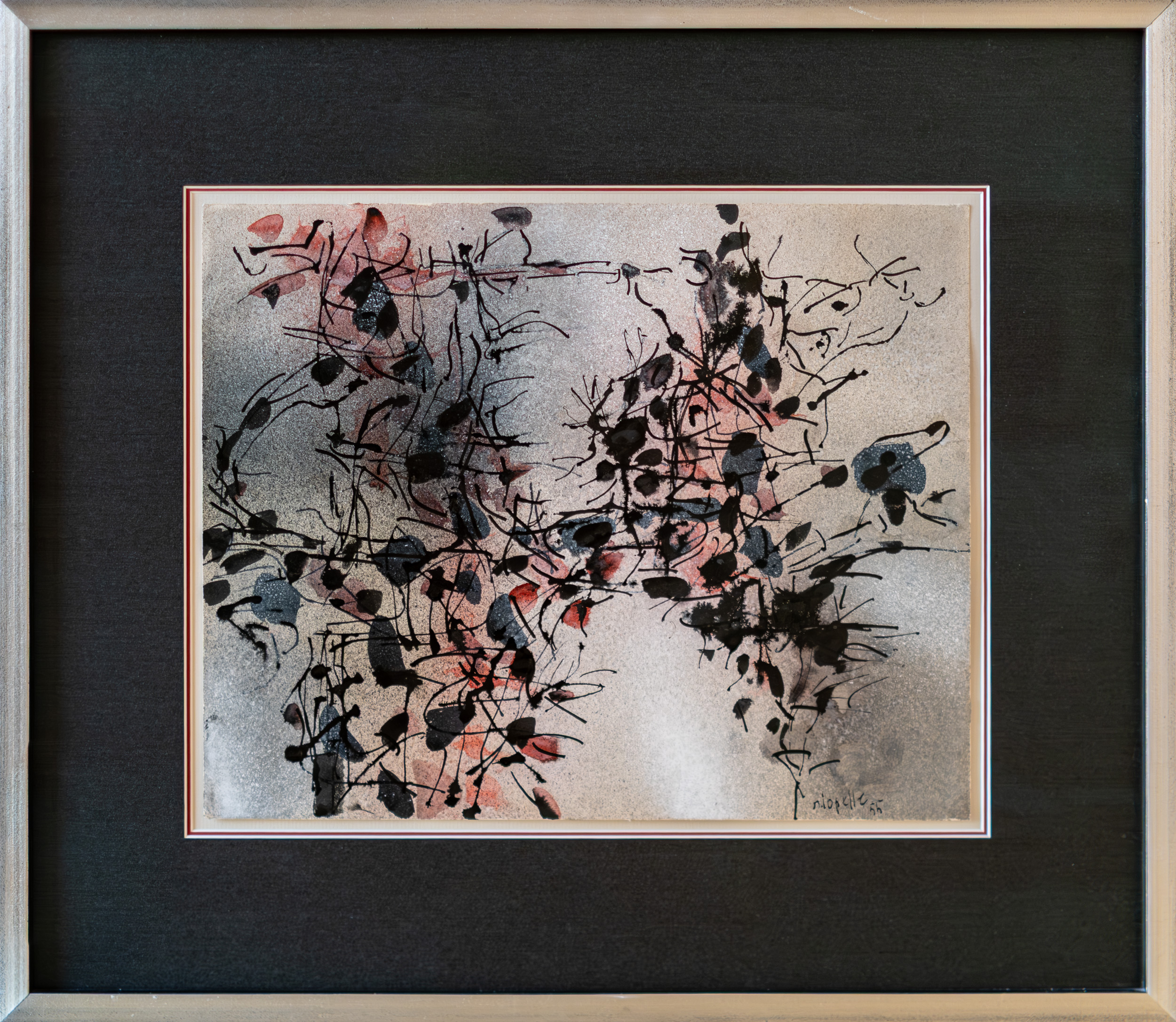
Composition 1955
More Works By Jean-Paul Riopelle Gouache 1955
14.5 × 18.13 in
36.83 × 46.05 cm
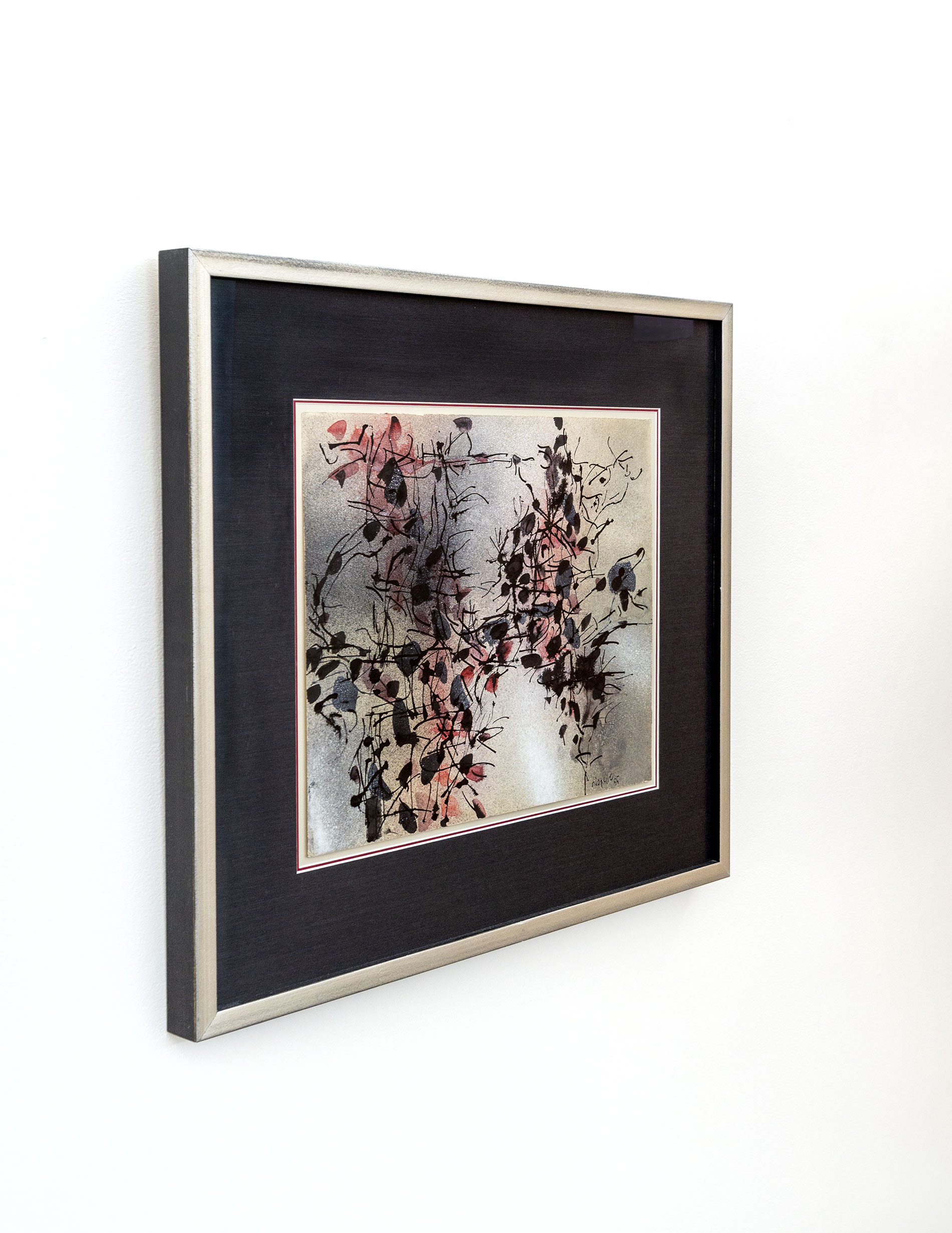
FRAMED
24 × 27.5 in
60.96 × 69.85 cm

 Copy Link
 Share by Email
About Composition 1955
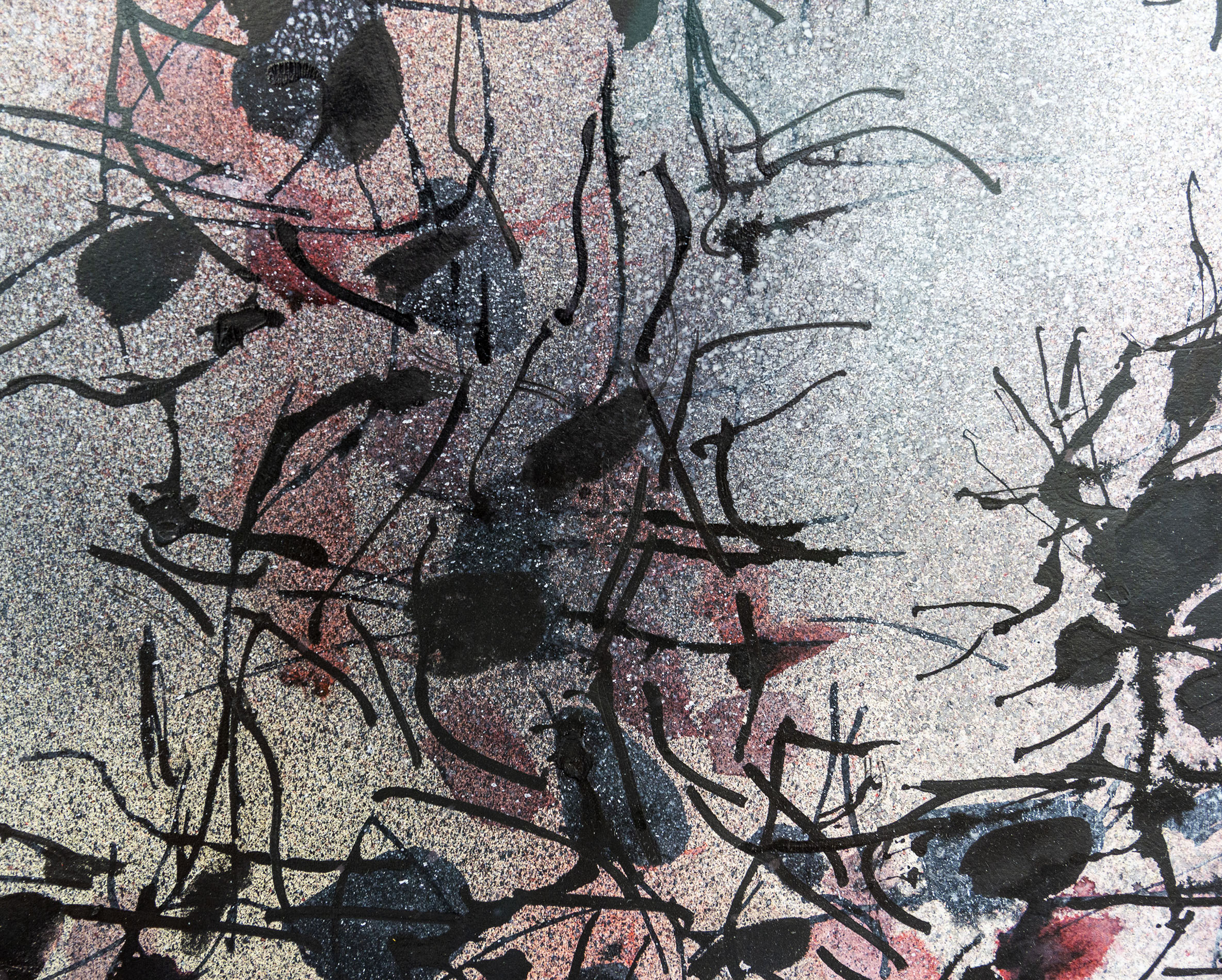
This unique abstract expressionist watercolor was painted by Jean-Paul Riopelle.This is a rare watercolor (gouache) by one of Canada’s most significant and influential artists of the twentieth century, Jean-Paul Riopelle. The Quebec-born artist had an international reputation as an innovative and superb abstract expressionist. This dynamic painting was one of his experiments with gouache created in Paris during the 1950s when he famously abandoned the paintbrush in favour of a palette knife. Delicate strokes of red, dark blue, and aubergine are dabbed onto the canvas, allowing for the neutral background to be exposed. Lyrical black markings—passages and long filaments were achieved by throwing the paint with a knife, a brush or from the paint tube directly onto the stretched canvas. Riopelle liked to finish a painting in one session, so he would typically pre-select his colors. He was an extraordinarily prolific artist who created more than 2,000 paintings in his lifetime.
“There is no abstraction or figuration: there is only expression, and to express oneself is to place oneself in front of things. To abstract means to remove, to isolate, to separate. To the contrary, I seek to add, approach and link.”
Jean-Paul Riopelle
“If Riopelle is a pillar of our history, it is because he was first and foremost a visionary and an explorer, and that is precisely what made him an eminently contemporary artist. In both the past and the present, Riopelle stands, in this sense, at a crossroads in time.”
Sylvie Lacerte, art historian, author and independent researcher.
Jean-Paul Riopelle (1923 to 2002) was born in Montreal. He was drawn to art at a very early age and took drawing and painting lessons. In 1942, after a preparatory year, Riopelle began his studies in engineering, architecture and photography at École Polytechnique de Montréal. In 1943, Riopelle took a few classes at École des Beaux-Arts and enrolled at École du Meuble, where he created his first abstract paintings. He took his first trip to France in 1946, where he would end up living for decades. There, he participated in numerous avant-garde groups, including the École de Paris and, in Montreal, Les Automatistes, a group of artists known for their spontaneous style of painting. In 1948, Riopelle signed the Refus Global, the manifesto that announced the Quebecois artistic community’s refusal of clericalism and provincialism. His artworks, paintings, engravings and sculptures have been widely exhibited throughout the world and are part of many public collections (notably the National Gallery of Canada and the Museum of Metropolitan Art in NYC) in more than 60 cities in 18 countries and on 6 continents.