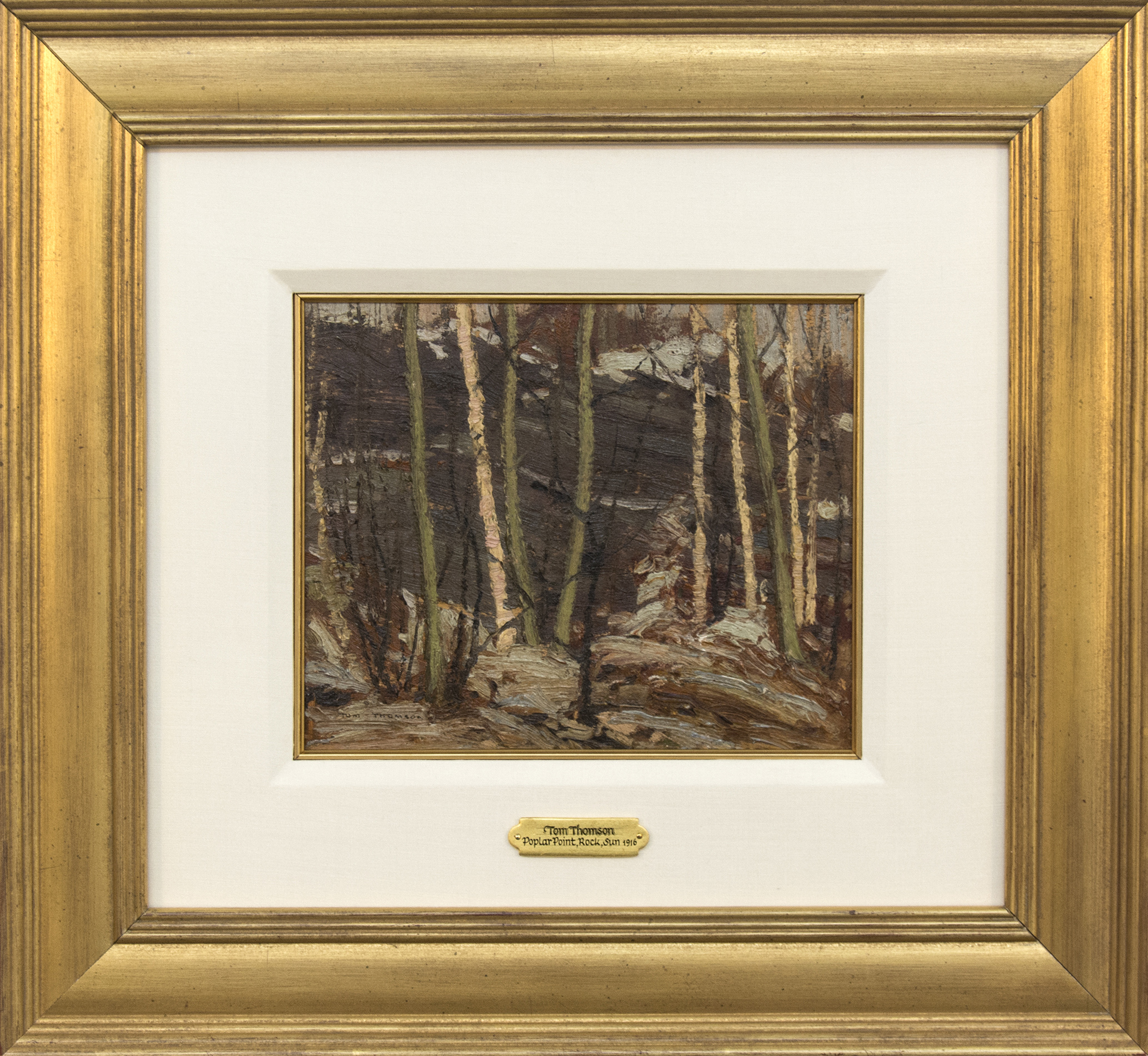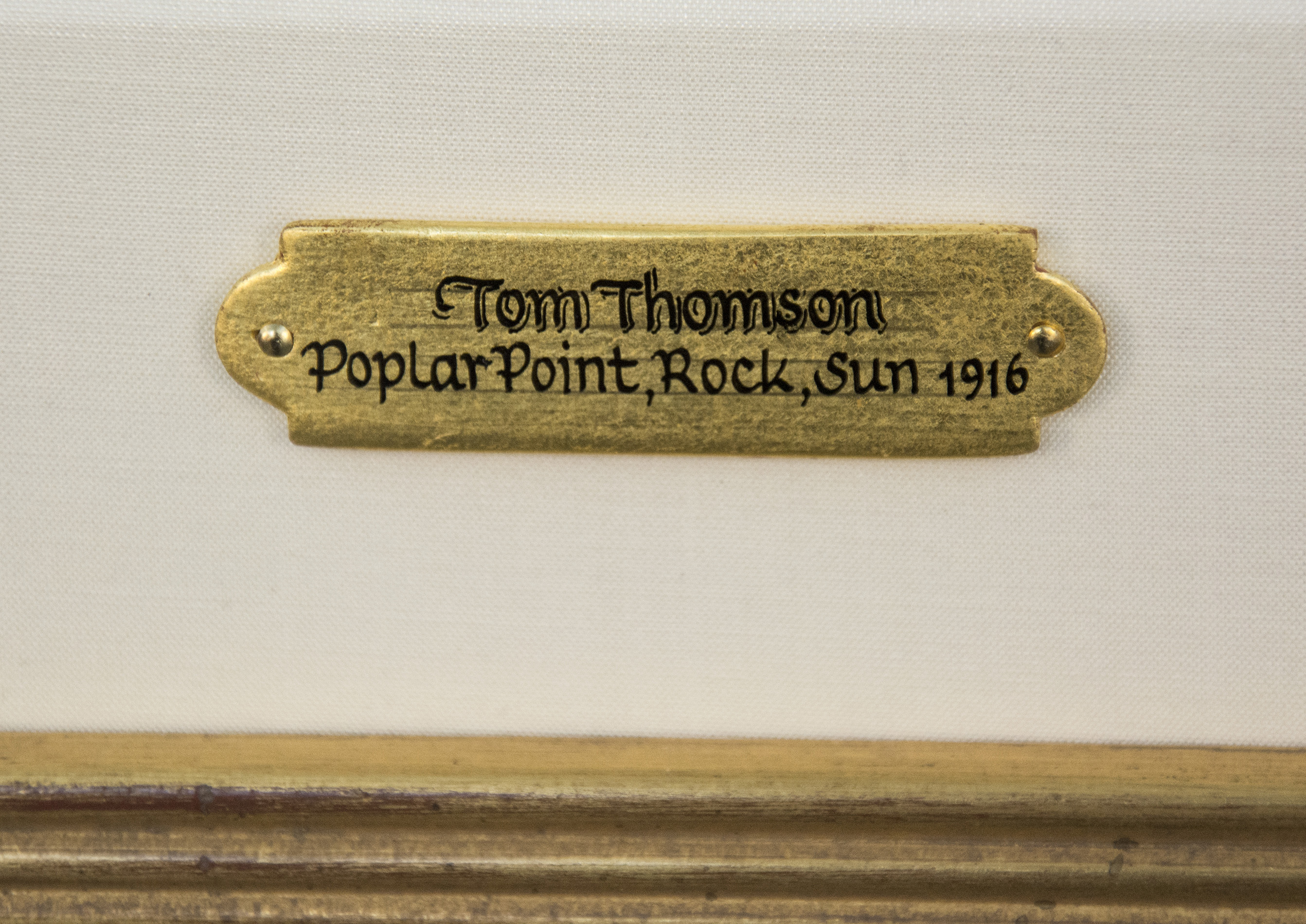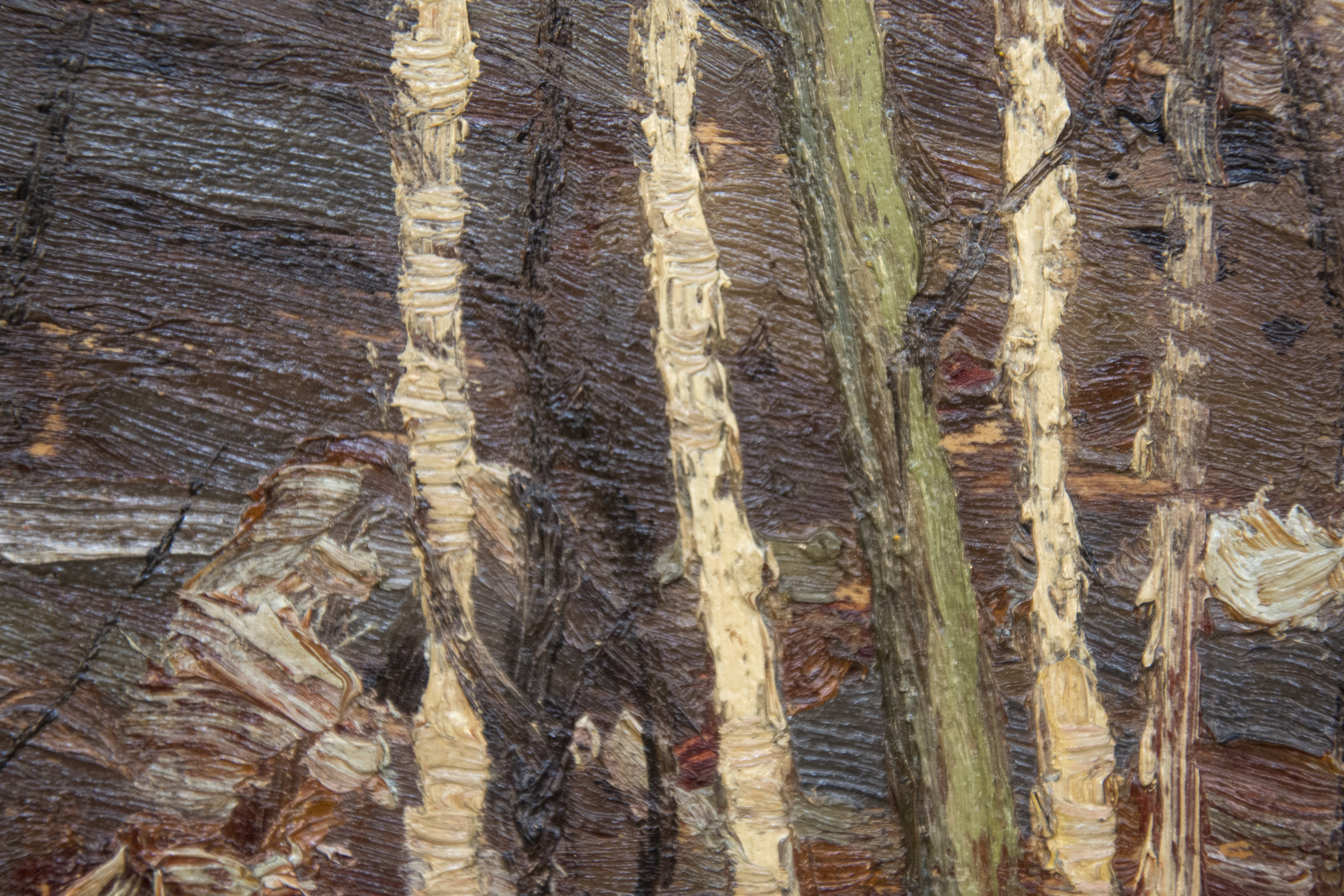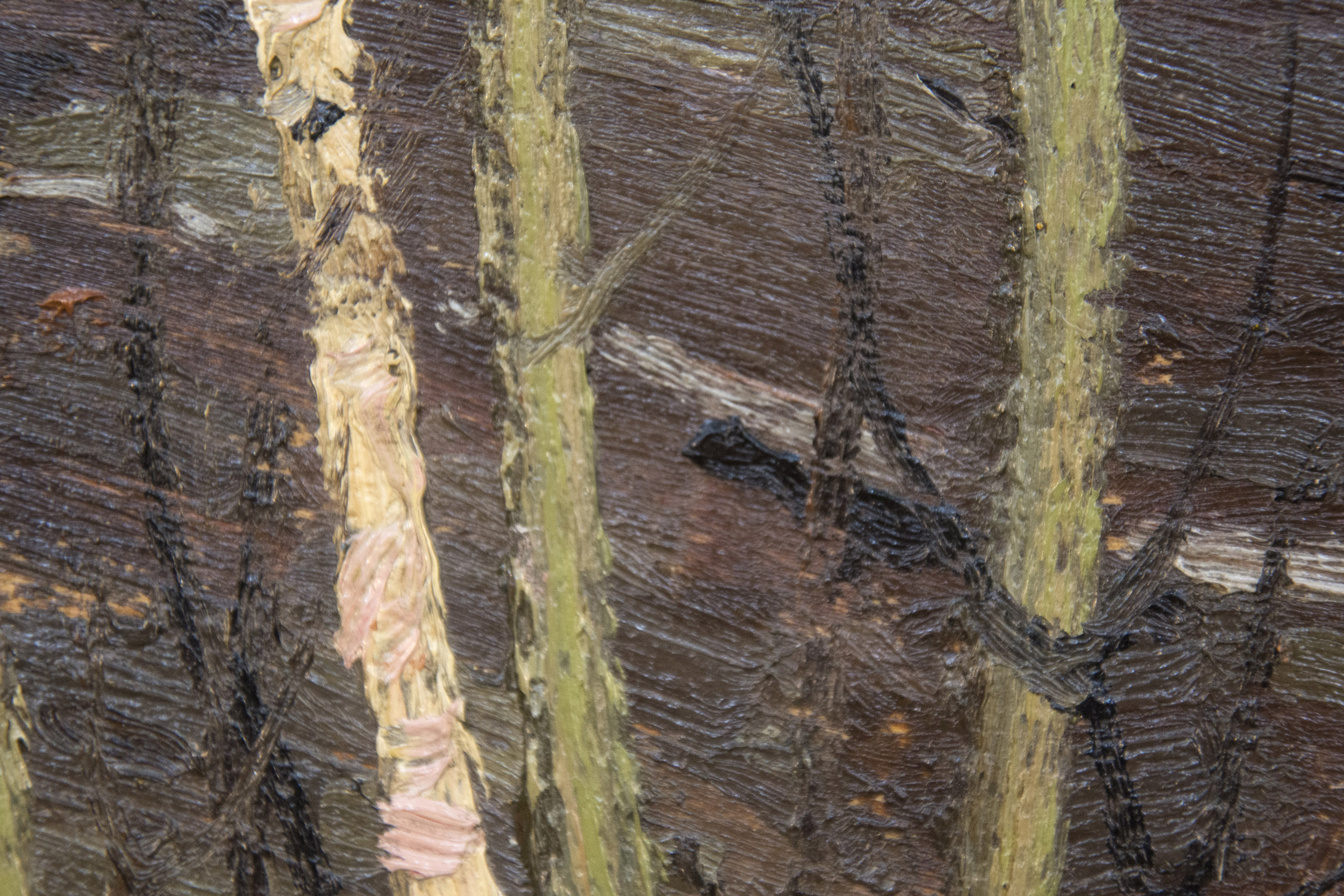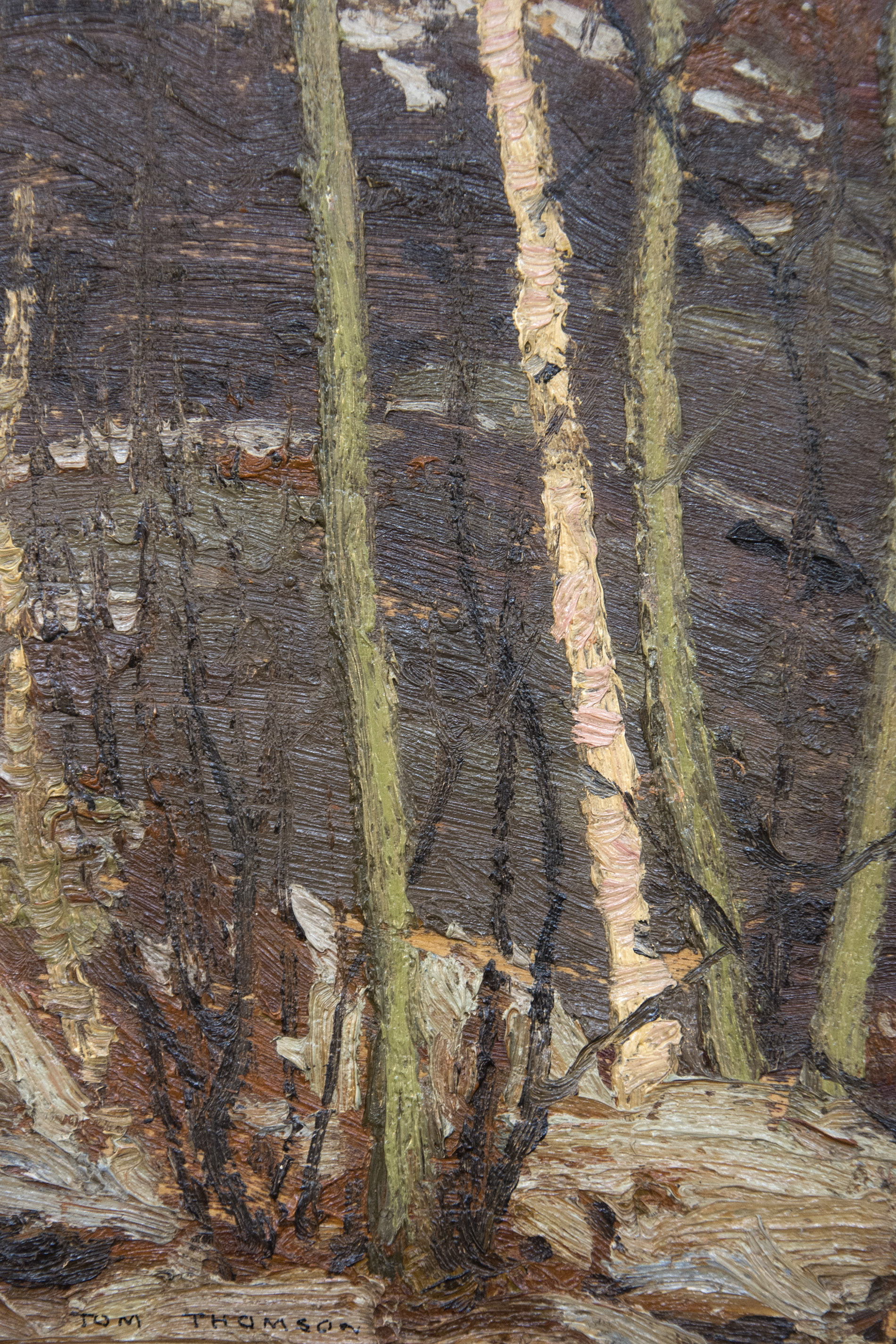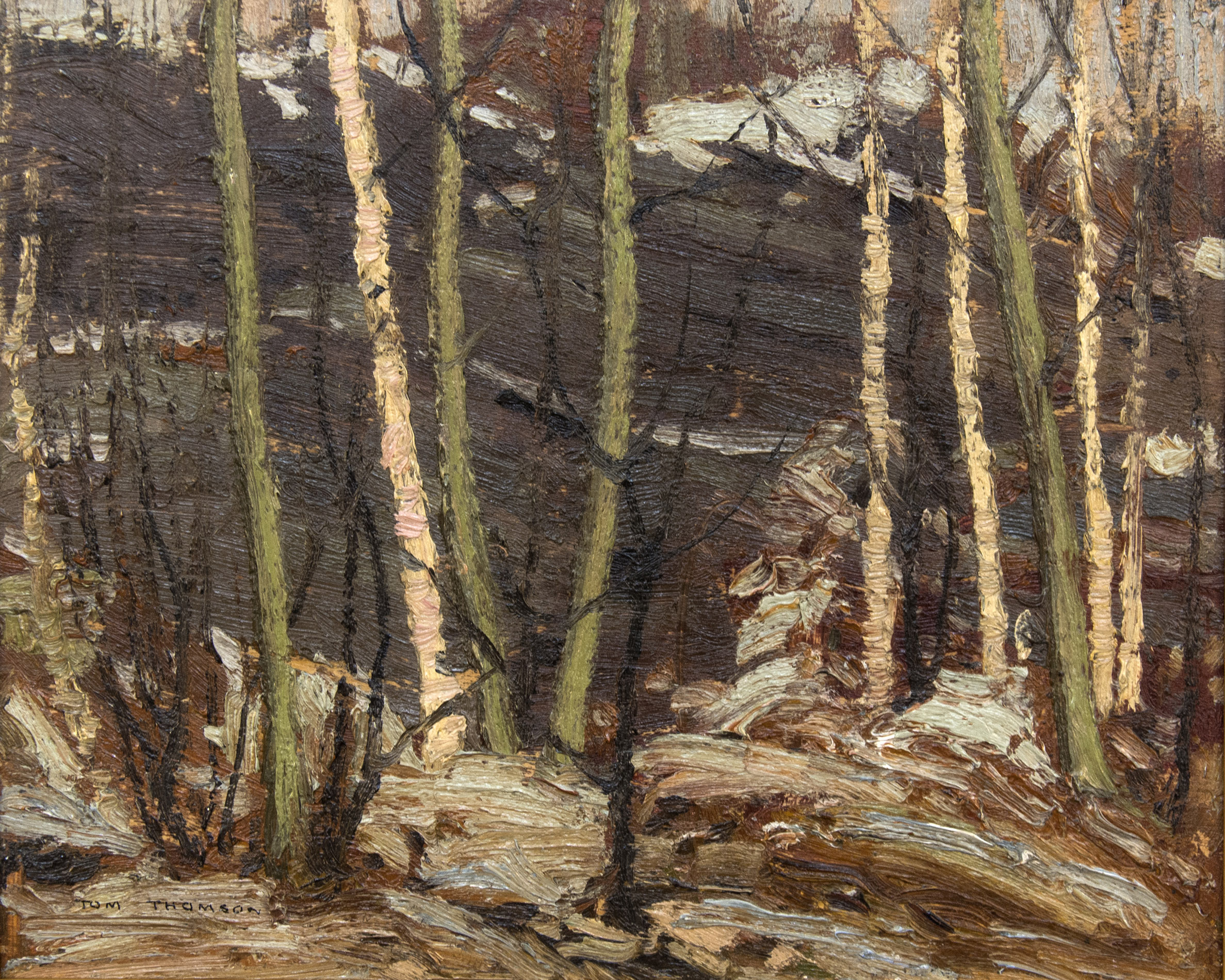
Poplar Point; Rock and Sun
More Works By Tom Thomson Oil on Panel 1916
8.5 × 10.5 in
21.59 × 26.67 cm
Inquire for pricing

 Copy Link
 Share by Email
About Poplar Point; Rock and Sun
This oil landscape painting of trees in the north is by the iconic artist Tom Thomson, who influenced the Group of Seven.Tom Thomson is considered one of Canada’s most important artists, celebrated globally as a fine landscape painter. Known for his intuitive ability to capture the colours and the light of the rugged, unspoiled beauty of the Northern wilderness, Thomson’s canvases are imbued with emotional depth. In his short career, he was a prolific painter, creating about 50 canvases and 500 sketches over a five-year period.
This oil on board is a rare find—one of the paintings found in Thomson’s catalogue raisonné…the record of his complete oeuvre. This painting also appeared in a 1952 exhibit at the National Gallery of Canada in Ottawa under the name ‘Trees.’ The grove of bare poplar trees stands against a hilly, rocky landscape rendered in a rich palette of earthy colours—browns, black, green, and creamy white. Thomson’s unique, colourful, and expressive style heavily influenced the artwork of the renowned Group of Seven, which formed after Thomson’s death. Artists Lawren Harris, Frederick Varley, A.Y. Jackson, Arthur Lismer, and J. E. H. Macdonald had often accompanied Tom Thomson on camping, painting and fishing trips to Algonquin Park.
“Jackson and myself have been making quite a few sketches lately, and I will send a bunch down with Lismer when he goes back. He & Varley are greatly taken with the look of things here, just now the maples are about all stripped of leaves, but the birches are very rich in colour. We are all working away, but the best I can do is not do the place much justice in the way of beauty.” Tom Thomson
“Thomson painted not merely to paint, but because his nature compelled him to paint — because he had a message. The North Country gradually enthralled him, body and soul. He expressed the emotions of the country, its moods and passions, and all the sombreness and glory of colour. Words were not his instruments of expression. Colour was the only medium open to him.”
(Dr. James MacCallum, patron of Tom Thomson)
“The light on the landscapes Thomson painted was particularly adroit and subtle. One can almost calculate the exact time of day and the quality of the air from the colours he used. This aspect of Thomson’s achievement is what charges his work with strong emotion and refinement at the same time.” David P. Silcox, Tom Thomson: Life and Work, Art Canada Institute
Thomas John “Tom” Thomson was born on August 5, 1877, near Claremont, Ontario, one of ten children. As a young man, he developed a love for the outdoors, fishing, and sports. Thomson trained as a commercial graphic artist and worked in Seattle and Toronto. Early in his career, he met several artists who would become the renowned Group of Seven. Inspired by wilderness trips in the north, Thomson began painting seriously around 1911. His style was distinctive, colourful and expressive, likely influenced by his commercial work. He made his first trip to Algonquin Park in 1912, and the images he sketched and painted then would influence his work for the rest of his life. Thanks to the generous financial assistance of a patron, a Toronto University Professor named Dr. James MacCallum Thomson was able to leave his job and paint full-time by 1913. Tragically, in the summer of 1918, Tom Thomson drowned in a canoeing accident on Canoe Lake in Algonquin Park under circumstances which remain a mystery. Thomson’s work is collected throughout the world, both privately and publicly. The National Gallery of Canada has the largest collection of his original work. The Art Gallery of Ontario, the McMichael Canadian Art Collection in Kleinburg, Ontario and the Tom Thomson Memorial Art Gallery in Owen Sound also have significant collections.